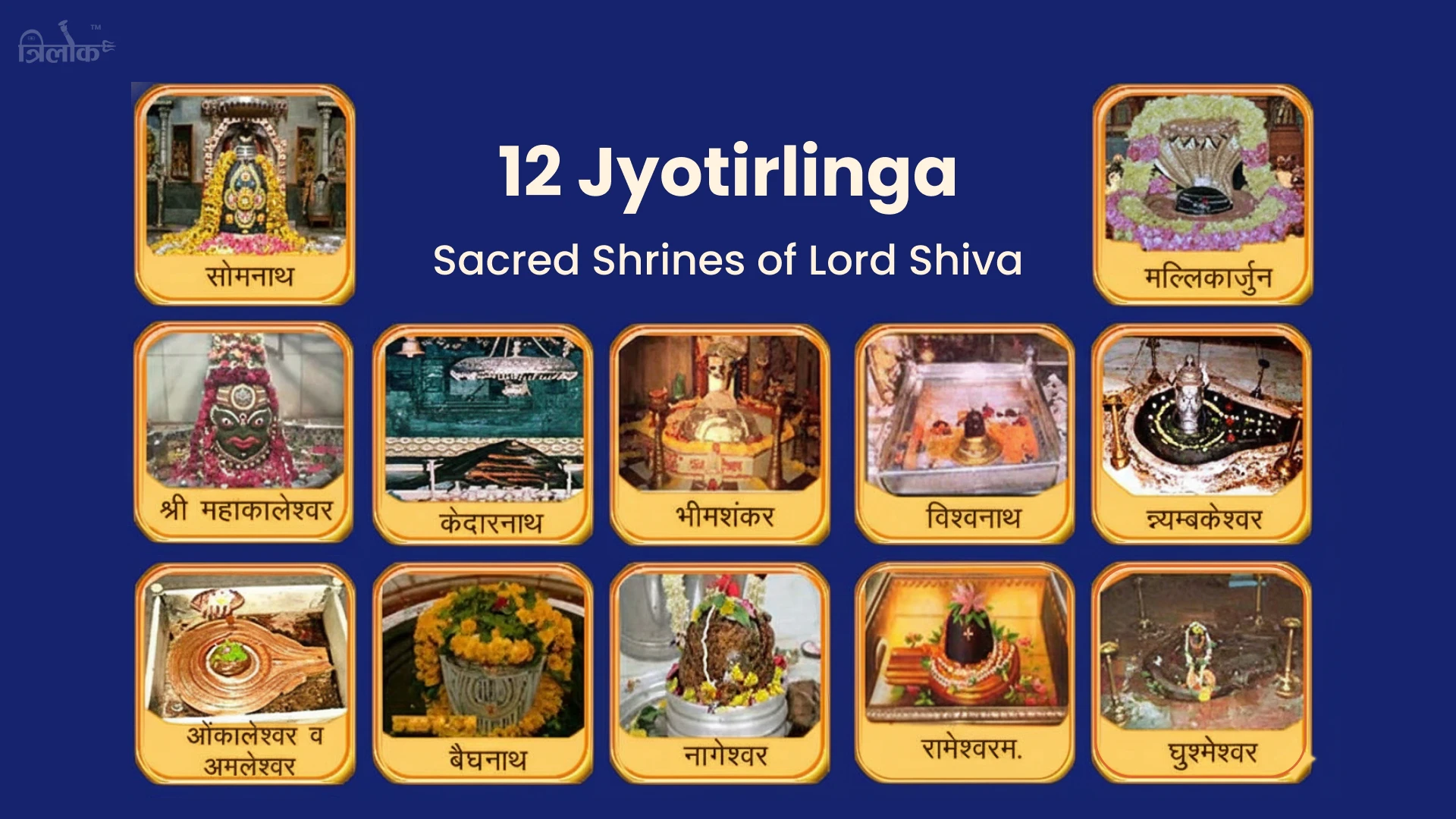
12 Jyotirlingas – Explore the Divine Shiva Temples Across India
April 21, 2026 Tuesday
1. Somnath Jyotirlinga
Location: Prabhas Patan, Gujarat
Somnath is revered as the first among the 12 Jyotirlingas. It holds immense historical and spiritual significance.
The Legend of Chandra (The Moon God)
According to legend, Prajapati Daksha cursed the Moon God, Chandra, to lose his brilliance because he favored his wife Rohini over Daksha’s other 26 daughters. Chandra worshipped Lord Shiva at this spot to seek redemption. Shiva blessed him with the cycle of waxing and waning, restoring his light and establishing the first Jyotirlinga here.
2. Nageshwar Jyotirlinga
Location: Near Dwarka, Gujarat
This Jyotirlinga stands in the land of Lord Krishna. It is characterized by a magnificent 25-meter-tall statue of Lord Shiva that can be seen from a distance.
The Destroyer of Daruka
Lord Shiva resides here as Nageshwar (Lord of Snakes) alongside Goddess Parvati as Nageshwari. The temple marks the spot where Shiva appeared to destroy the demon Daruka to protect his devotees.
3. Bhimashankar Jyotirlinga
Location: Pune, Maharashtra
Situated on the banks of the Bhima River, this temple is a blend of ancient legend and natural beauty. It is an important center for pilgrims in Maharashtra.
Historical Significance
Legend attributes the temple’s origins to Bhima, the son of Kumbhakarna. The presence of a nearby temple dedicated to Goddess Parvati emphasizes the eternal bond of Shiva-Shakti. (Note: Some traditions also associate this Jyotirlinga with locations near Kamakhya in Assam).
4. Trimbakeshwar Jyotirlinga
Location: Nashik, Maharashtra
Located on the Brahmagiri Hill, this temple marks the source of the sacred Godavari River (Gautami Ganga).
The Unique Trinity
Unlike other Jyotirlingas, the main linga here has three faces representing the Hindu Trinity: Lord Brahma, Lord Vishnu, and Lord Shiva. It was established after Sage Gautama prayed to Lord Shiva to bring the Ganges to this region to purify the land.
5. Grishneshwar Jyotirlinga
Location: Aurangabad (Sambhaji Nagar), Maharashtra
Located near the world-famous Ellora Caves, this temple is an architectural marvel made of red stone and exquisite carvings.
The Devotion of Ghushma
Lord Shiva appeared here to bless his ardent devotee, Ghushma. The name “Grishneshwar” (Lord of Compassion) serves as a reminder of Shiva’s love for his followers. It is historically recognized as the last of the 12 Jyotirlingas.

6. Vaidyanath Jyotirlinga
Location: Deoghar, Jharkhand
Located in the heart of Jharkhand, this temple holds the sacred Atmalinga. It is a major pilgrimage site, especially during the Shravan Mela.
The Legend of Ravana
According to legend, Lord Shiva gave the Atmalinga to Ravana. However, it was ordained that if the Linga were ever placed on the ground, it would remain fixed there forever. When Ravana placed it on the ground at this spot in Deoghar, it became permanently established as a Jyotirlinga.
7. Mahakaleshwar Jyotirlinga
Location: Ujjain, Madhya Pradesh
Lord Shiva appears here as Mahakal, the Lord of Time and Death. This temple is unique as it is the only south-facing (Dakshinmukhi) Jyotirlinga, a position held in high regard in tantric traditions.
The Bhasma Aarti
The temple is world-famous for its Bhasma Aarti. Legend says that Shiva revealed himself at this spot in response to the deep and selfless devotion of a young child, promising to protect his devotees from the fear of death.
8. Omkareshwar Jyotirlinga
Location: Khandwa, Madhya Pradesh
Situated on an island called Mandhata in the Narmada River, the island itself is naturally shaped like the Om symbol (ॐ).
The Blessing of King Mandhata
Lord Shiva appeared here, pleased by the intense penance of King Mandhata. A pilgrimage to this site is traditionally considered complete only after visiting the nearby Mamleshwar temple on the opposite bank of the river.
9. Kashi Vishwanath Jyotirlinga
Location: Varanasi, Uttar Pradesh
Varanasi (Kashi) is often called the city of Lord Shiva. This Jyotirlinga is considered the first place where Shiva’s infinite energy manifested in the material world.
The Abode of Salvation
It is said that when Lord Shiva is not at Mount Kailash, he resides in Kashi. Devotees believe that a visit to Vishwanath provides Moksha (salvation) and immense joy, freeing the soul from the cycle of rebirth.
10. Kedarnath Jyotirlinga
Location: Rudraprayag, Uttarakhand
Standing at a breathtaking altitude of nearly 12,000 feet in the Himalayas, Kedarnath is one of the four sacred Char Dhams and the most remote of the 12 Jyotirlingas.
The Pandavas’ Penance
The Pandavas are said to have built this temple at the end of the Kurukshetra war to seek Lord Shiva’s forgiveness. Shiva, taking the form of a bull, eventually dived into the ground, leaving his hump behind, which is worshipped here today.
11. Rameshwaram Jyotirlinga
Location: Rameshwaram Island, Tamil Nadu
This temple marks the southernmost Jyotirlinga and is deeply connected to the epic Ramayana.
The Worship of Lord Rama
Before his battle with the demon king Ravana, Lord Rama installed the Shiva Linga here and worshipped his deity to ensure victory. This act of divine worship marked the beginning of his expedition to Lanka.
12. Mallikarjuna Jyotirlinga
Location: Srisailam, Andhra Pradesh
Known as the “Kailash of the South,” this sacred temple stands atop Srisailam Hill on the banks of the Krishna River.
Shiva-Shakti Union
Lord Shiva and Parvati came here to pacify their son, Kartikeya. In this temple, Shiva resides as Arjuna and Parvati as Mallika. Uniquely, this site is both a Jyotirlinga and houses the Bhramarambika Shakti Peeth, representing the perfect union of Shiva and Shakti.