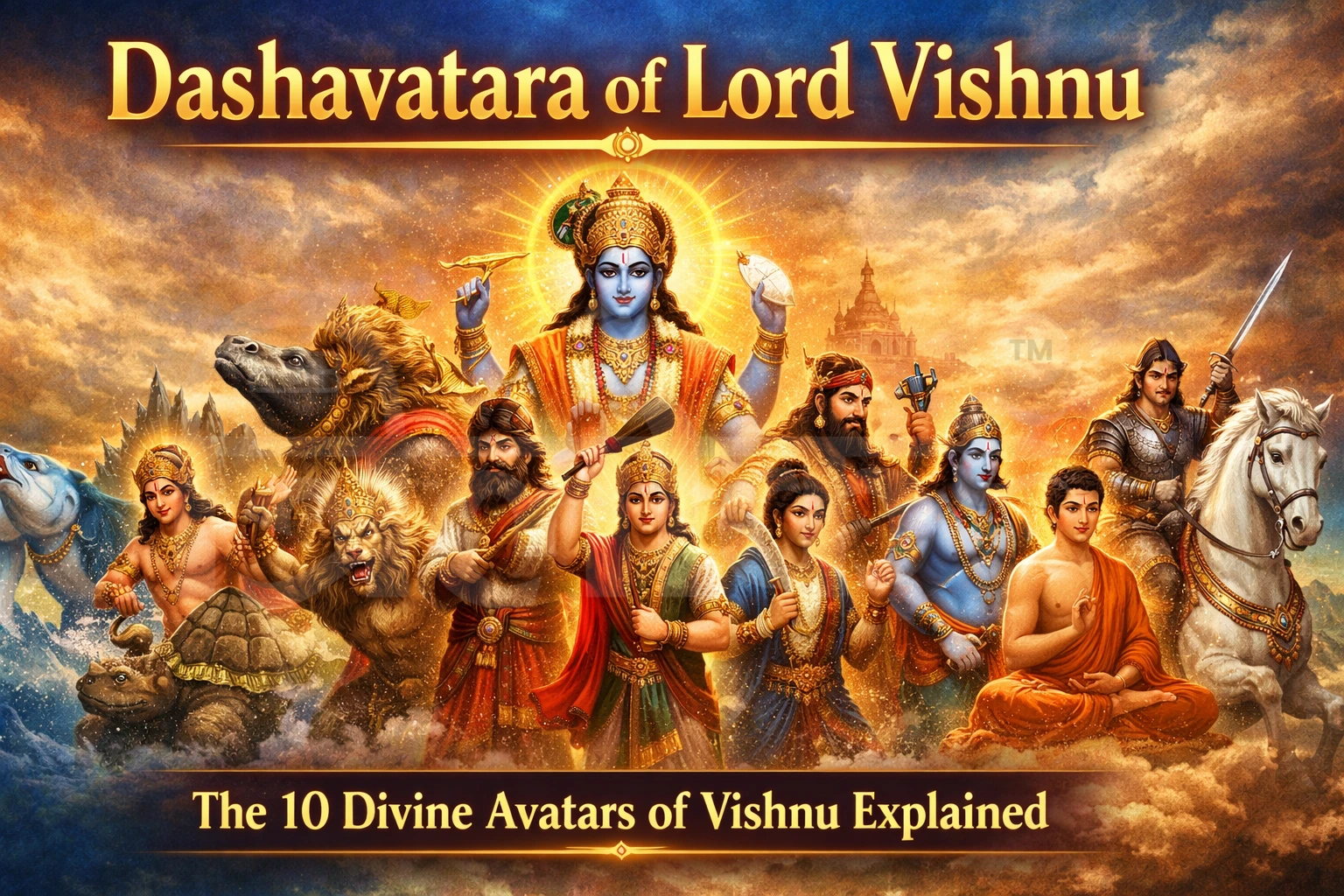
Why Lord Vishnu Takes Avatars: The Complete Story of the Dashavatara
March 14, 2026 Saturday
Why Lord Vishnu Takes Avatars: The Complete Story of the Dashavatara
In Hindu philosophy, the universe is governed by a balance between dharma (righteousness, truth, and moral order) and adharma (injustice, chaos, and immorality). Maintaining this balance is essential for the harmony of the world and the well-being of all living beings.
Among the Trimurti—Brahma the creator, Vishnu the preserver, and Shiva the transformer—Lord Vishnu plays the vital role of preserving and protecting the universe. His responsibility is to ensure that dharma remains established and that destructive forces do not dominate creation.
However, history and mythology describe many periods when evil forces grew powerful and threatened harmony. During such times, Lord Vishnu manifests on Earth in different forms known as avatars. These incarnations appear with a specific mission: to defeat powerful demons, guide humanity, protect devotees, and restore righteousness.
The ten principal incarnations of Vishnu are collectively known as the Dashavatara. Each avatar appears in a particular era and represents a unique response to a crisis affecting the world.
These stories are described in ancient Hindu scriptures such as the Puranas, the Ramayana, and the Mahabharata. Beyond mythology, the Dashavatara also symbolizes deeper philosophical lessons about justice, humility, devotion, and the evolution of life and consciousness.
This article explores why Lord Vishnu takes avatars and the detailed stories behind each of the ten incarnations, explaining their significance in Hindu tradition.
Why Lord Vishnu Takes Avatars
The concept of incarnation is one of the most important teachings in Hindu philosophy. The Sanskrit word “avatar” means “descent”, referring to the descent of energy into the physical world.
According to Hindu belief, the universe moves through cycles of time called Yugas. Over time, moral values decline and injustice begins to dominate society. When this imbalance becomes severe, intervention becomes necessary.
The purpose of Vishnu’s avatars is clearly explained in the Bhagavad Gita (Chapter 4, Verse 7–8) where Lord Krishna declares:
“Whenever there is a decline in righteousness and an increase in unrighteousness, I manifest myself on Earth.
To protect the good, destroy evil, and re-establish dharma, I appear age after age.”
This principle forms the foundation of the Dashavatara concept.
Key Purposes of Vishnu’s Avatars
Lord Vishnu incarnates for several important reasons:
1. To Restore Dharma
When injustice, corruption, and cruelty become widespread, Vishnu takes birth to restore moral order and guide humanity back toward righteous living.
2. To Defeat Powerful Demons
Many avatars appear to defeat powerful demons or tyrants who have gained supernatural powers and threaten the universe.
3. To Protect Devotees
Vishnu is known as the protector of devotees. Whenever sincere devotees face danger from evil forces, he intervenes through an avatar.
4. To Guide Humanity
Some avatars appear not only to defeat evil but also to teach spiritual wisdom and moral values.
5. To Maintain Balance
The avatars represent intervention that prevents chaos and ensures the continued functioning of the universe.
The Dashavatara: Ten Avatars of Lord Vishnu
The Dashavatara refers to the ten major incarnations of Lord Vishnu that appear across different ages of the universe.
These avatars are:
-
Matsya (The Fish)
-
Kurma (The Tortoise)
-
Varaha (The Boar)
-
Narasimha (The Man-Lion)
-
Vamana (The Dwarf Brahmin)
-
Parashurama (The Warrior Sage)
-
Rama (The Ideal King)
-
Krishna (The Teacher)
-
Buddha (The Enlightened One)
-
Kalki (The Future Warrior)
Each avatar carries a powerful story and deep symbolic meaning.
1. Matsya Avatar – The Savior During the Great Flood
Why Vishnu Took the Matsya Avatar
The Matsya avatar appeared during a time when a great cosmic flood threatened to destroy all life on Earth. At the same time, sacred knowledge contained in the Vedas had been stolen by a powerful demon named Hayagriva.
Without the Vedas, humanity would lose its spiritual wisdom and moral guidance.
To protect both life and sacred knowledge, Lord Vishnu incarnated as Matsya, a giant divine fish.
The Story of Matsya Avatar
According to legend, a wise king named Manu was performing rituals by the river when he found a tiny fish seeking protection from larger fish.
Manu placed the fish in a small container, but it quickly grew larger. He then moved it into a pond, then a lake, and finally into the ocean.
At that moment, the fish revealed its divine form as Lord Vishnu.
Matsya warned Manu about the coming flood and instructed him to build a large boat. Manu was told to gather seeds, animals, sages, and sacred scriptures to preserve life.
When the great flood arrived, Matsya appeared with a giant horn. Manu tied the boat to the horn using a serpent as a rope. The divine fish guided the boat safely across the waters until the flood subsided.
Matsya also defeated the demon Hayagriva and recovered the stolen Vedas.
Significance of the Matsya Avatar
The Matsya avatar symbolizes:
-
Preservation of knowledge
-
Protection during catastrophic destruction
-
The beginning of a new cycle of creation
2. Kurma Avatar – Supporting the Cosmic Churning
Why Vishnu Took the Kurma Avatar
In ancient times, the gods lost their strength due to a curse and became vulnerable to demons. To regain their power, they needed the nectar of immortality (Amrit) hidden in the cosmic ocean.
To obtain it, the gods and demons agreed to churn the ocean of milk, a process known as Samudra Manthan.
However, the mountain used as the churning rod began sinking into the ocean.
To support the mountain, Vishnu took the form of Kurma, a giant tortoise.
The Story of Kurma Avatar
The gods used Mount Mandara as the churning rod and the serpent Vasuki as the rope.
As the churning began, the mountain started sinking into the ocean because it had no support.
At that moment, Vishnu appeared as a massive tortoise and supported the mountain on his back.
The churning continued for thousands of years and produced many divine treasures including:
-
Goddess Lakshmi
-
The divine physician Dhanvantari
-
The wish-fulfilling tree Kalpavriksha
-
The nectar of immortality
With Kurma’s support, the gods eventually obtained the nectar and regained their strength.
Significance of the Kurma Avatar
The Kurma avatar represents:
-
Stability and support during cosmic events
-
Cooperation between opposing forces
-
The emergence of prosperity and divine gifts
3. Varaha Avatar – The Rescue of Earth
Why Vishnu Took the Varaha Avatar
During the early stages of creation, the universe was threatened by a powerful demon named Hiranyaksha, who belonged to the race of Daityas. Hiranyaksha was extremely strong and arrogant due to the blessings he had received from the creator god Brahma.
With his immense strength, Hiranyaksha began challenging the gods and disturbing the natural balance of the universe. Eventually, he dragged the entire Earth (Bhudevi) into the depths of the ocean.
With the Earth submerged in water, creation was thrown into chaos. The gods were unable to restore the planet to its rightful position, and life could not continue without the stability of Earth.
To rescue the planet and defeat the demon responsible for this destruction, Lord Vishnu manifested as Varaha, a giant boar.
The Story of Varaha Avatar
According to the Puranas, Lord Vishnu emerged from the waters in the form of a colossal boar. His roar echoed through the universe, announcing the arrival of power.
Varaha dived deep into the ocean to search for the Earth. At the bottom of the ocean, he found the planet trapped under the control of the demon Hiranyaksha.
A fierce battle began between Varaha and Hiranyaksha. The fight continued for a long time, shaking the heavens and the earth.
Eventually, Varaha defeated the demon with his immense strength.
After killing Hiranyaksha, Varaha gently lifted the Earth from the ocean using his large tusks. Carrying the planet carefully, he rose above the waters and restored it to its rightful place in the universe.
With the Earth saved and balance restored, the gods praised Vishnu for protecting creation.
Significance of the Varaha Avatar
The Varaha avatar represents several important symbolic meanings:
-
The protection of Earth and nature
-
The restoration of balance
-
The triumph of power over destructive forces
This avatar also emphasizes that the preservation of the world is essential for the continuation of life and dharma.
4. Narasimha Avatar – The Defender of Devotion
Why Vishnu Took the Narasimha Avatar
The demon king Hiranyakashipu, the brother of Hiranyaksha, sought revenge against Lord Vishnu for killing his brother.
To gain immense power, Hiranyakashipu performed severe penance and pleased Lord Brahma, who granted him a powerful boon.
The boon made him almost impossible to kill. According to the conditions:
-
He could not be killed by a human or animal.
-
He could not die during the day or night.
-
He could not be killed indoors or outdoors.
-
He could not die on land or in the sky.
-
No weapon could kill him.
Believing himself to be invincible, Hiranyakashipu declared himself a god and demanded that everyone worship him.
However, his own son Prahlada was a devoted follower of Lord Vishnu. Despite his father’s threats and punishments, Prahlada refused to stop worshipping Vishnu.
To protect Prahlada and destroy the tyrant, Vishnu manifested in a unique and powerful form.
The Story of Narasimha Avatar
One day, Hiranyakashipu asked Prahlada where his god Vishnu could be found. Prahlada calmly replied that Vishnu exists everywhere.
Enraged, Hiranyakashipu struck a pillar in his palace and demanded that Vishnu appear.
At that moment, the pillar split open and Lord Vishnu emerged as Narasimha, a terrifying form that was half-man and half-lion.
At twilight—neither day nor night—Narasimha dragged Hiranyakashipu to the palace threshold, which was neither indoors nor outdoors.
Placing the demon on his lap, which was neither earth nor sky, Narasimha tore him apart with his claws, which were not weapons.
In this way, Vishnu cleverly fulfilled all the conditions of the boon while defeating the demon.
After the battle, Narasimha calmed down when Prahlada approached him with devotion.
Significance of the Narasimha Avatar
The Narasimha avatar teaches powerful spiritual lessons:
-
True devotion is always protected by power
-
Arrogance and tyranny eventually lead to destruction
-
intelligence surpasses any worldly power
This story remains one of the most dramatic and symbolic narratives in Hindu mythology.
5. Vamana Avatar – The Lesson of Humility
Why Vishnu Took the Vamana Avatar
The demon king Mahabali, also known as Bali, was one of the most powerful rulers of his time. Through strength and determination, he conquered the heavens, earth, and the underworld.
Although Bali was known for his generosity and devotion, his growing power disturbed the balance between gods and demons.
The gods approached Lord Vishnu for help in restoring balance.
Instead of destroying Bali through battle, Vishnu chose a more peaceful and intelligent solution.
The Story of Vamana Avatar
Lord Vishnu incarnated as Vamana, a small Brahmin boy.
At that time, King Bali was performing a grand sacrificial ceremony where he promised to grant any request made by a Brahmin.
Vamana approached the king and humbly asked for three steps of land.
Bali laughed at the modest request and immediately agreed.
However, the moment Bali granted the wish, Vamana began to grow into a gigantic form.
With his first step, he covered the entire Earth.
With his second step, he covered the heavens.
There was no place left for the third step.
Realizing the nature of the visitor, Bali bowed in humility and offered his own head for the final step.
Vishnu placed his foot on Bali’s head and pushed him to the underworld but blessed him for his devotion and generosity.
Significance of the Vamana Avatar
The Vamana avatar highlights important values:
-
The importance of humility
-
The balance between power and righteousness
-
The idea that true devotion earns blessings
This story also demonstrates that wisdom and intelligence can overcome even the greatest power.
6. Parashurama Avatar – The Warrior Sage
Why Vishnu Took the Parashurama Avatar
Over time, many rulers and warriors became arrogant and began misusing their authority. These corrupt kings oppressed ordinary people and ignored the principles of justice and dharma.
The warrior class, known as Kshatriyas, was originally responsible for protecting society. However, when many rulers began exploiting their power, the balance of society was disturbed.
To restore justice and punish these corrupt rulers, Lord Vishnu incarnated as Parashurama, a warrior sage.
The Story of Parashurama
Parashurama was born to the sage Jamadagni and his wife Renuka.
Although he was born into a family of sages, Parashurama was also trained in warfare and became a powerful warrior. Lord Shiva gifted him a axe, which became his primary weapon.
When a tyrannical king named Kartavirya Arjuna attacked Jamadagni’s hermitage and killed the sage, Parashurama became furious.
In response, he began a campaign against corrupt rulers who abused their power.
According to legends, Parashurama defeated many tyrannical kings and restored justice across the land.
Unlike other avatars, Parashurama is believed to exist still and is said to appear in later stories of Hindu mythology.
Significance of the Parashurama Avatar
The Parashurama avatar represents:
-
The importance of justice and accountability
-
The responsibility of leaders to protect society
-
The idea that power should never be misused
7. Rama Avatar – The Ideal King
Why Vishnu Took the Rama Avatar
The demon king Ravana gained immense strength through intense penance and received powerful boons from Lord Brahma.
Because of these boons, Ravana could not be defeated by gods or celestial beings.
As Ravana’s arrogance grew, he began terrorizing the world and disturbing the balance of dharma.
To defeat Ravana, Lord Vishnu took birth as a human prince named Rama.
The Story of Lord Rama
Rama was born in the city of Ayodhya to Raja Dasharatha and Rani Kaushalya.
Rama was known for his wisdom, courage, and unwavering commitment to dharma.
However, due to palace politics, Rama was forced into exile for fourteen years along with his wife Sita and brother Lakshmana.
During this exile, Ravana kidnapped Sita and took her to Lanka.
Determined to rescue his wife, Rama formed alliances with the monkey king Sugriva and the devoted warrior Hanuman.
A massive war took place between Rama’s army and Ravana’s forces.
After an intense battle, Rama defeated Ravana and restored peace.
Following the victory, Rama returned to Ayodhya and ruled as an ideal king.
Significance of the Rama Avatar
Lord Rama represents:
-
The ideal ruler and leader
-
Loyalty, duty, and righteousness
-
The victory of good over evil
His story is narrated in the epic Ramayana, one of the most influential texts in Hindu tradition.
8. Krishna Avatar – The Guide
Why Vishnu Took the Krishna Avatar
During the Dwapara Yuga, many evil rulers spread injustice and fear across the land.
One such ruler was King Kansa, who imprisoned his own sister Devaki after hearing a prophecy that her child would destroy him.
To defeat Kansa and guide humanity spiritually, Lord Vishnu incarnated as Krishna.
The Story of Krishna
Krishna was born in a prison in Mathura to Devaki and Vasudeva.
To protect the newborn child from Kansa, Vasudeva secretly carried Krishna across the Yamuna River to the village of Gokul, where he was raised by Nanda and Yashoda.
During his childhood, Krishna displayed powers and defeated several demons sent by Kansa.
Later, Krishna returned to Mathura and killed Kansa, freeing the kingdom from tyranny.
Krishna later played a crucial role in the epic Mahabharata.
As the charioteer of the warrior Arjuna, Krishna delivered the teachings of the Bhagavad Gita, one of the most important spiritual texts in Hindu philosophy.
Significance of the Krishna Avatar
Krishna represents:
-
wisdom and guidance
-
The path of devotion (Bhakti)
-
The importance of fulfilling one’s duty
9. Buddha Avatar – The Messenger of Compassion
Why Vishnu Took the Buddha Avatar
Over time, some religious practices became rigid and misunderstood, leading to unnecessary violence and suffering.
To restore compassion and spiritual understanding, Vishnu incarnated as Buddha.
The Story of Buddha
Prince Siddhartha Gautama was born into a royal family but later left his luxurious life after witnessing human suffering.
Through meditation and deep contemplation, he achieved enlightenment and became known as Buddha, meaning “the awakened one.”
He spent the rest of his life teaching people about compassion, mindfulness, and the path to liberation from suffering.
Significance of the Buddha Avatar
The Buddha avatar emphasizes:
-
Compassion toward all living beings
-
Nonviolence and peace
-
The search for spiritual enlightenment
10. Kalki Avatar – The Future Savior
Why Vishnu Will Take the Kalki Avatar
Hindu scriptures describe the current era as Kali Yuga, an age marked by moral decline, corruption, dishonesty, and conflict.
As the age progresses, righteousness will weaken and society will face increasing chaos.
At the end of Kali Yuga, Lord Vishnu will appear as Kalki, the final avatar.
The Future Story of Kalki
Kalki is described as a powerful warrior riding a white horse and wielding a blazing sword.
He will appear when injustice and corruption dominate the world.
Kalki will defeat the forces of evil and restore dharma.
After this, the cycle of time will reset, and a new age of truth and righteousness will begin.
Significance of the Kalki Avatar
The Kalki avatar represents:
-
The ultimate restoration of dharma
-
The end of corruption and darkness
-
The beginning of a new cycle
The Evolutionary Interpretation of the Dashavatara
Some scholars and researchers have observed an interesting connection between the Dashavatara of Lord Vishnu and the theory of biological evolution. Although Hindu scriptures were written thousands of years ago, the sequence of Vishnu’s avatars appears to symbolically mirror the gradual development of life on Earth.
While this interpretation is not universally accepted as scientific fact, many philosophers consider it a fascinating philosophical insight embedded in ancient mythology.
Evolutionary Sequence Reflected in the Dashavatara
The order of the avatars closely resembles the stages through which life evolved on Earth.
|
Avatar |
Form |
Possible Evolutionary Symbolism |
|
Matsya |
Fish |
Life begins in water |
|
Kurma |
Tortoise |
Transition from water to land |
|
Varaha |
Boar |
Development of land mammals |
|
Narasimha |
Half-man half-lion |
Evolution toward early human forms |
|
Vamana |
Dwarf human |
Early stage of human development |
|
Parashurama |
Warrior with axe |
Primitive human society using tools |
|
Rama |
Ideal civilized human |
Development of moral society |
|
Krishna |
Philosophical guide |
Intellectual and spiritual evolution |
|
Buddha |
Enlightened teacher |
Compassion and higher consciousness |
|
Kalki |
Future warrior |
Transformation and renewal |
This interpretation highlights how ancient Hindu mythology may contain symbolic reflections of humanity’s intellectual and spiritual evolution.
Rather than focusing only on mythology, the Dashavatara can also be viewed as a philosophical narrative of the growth of civilization and consciousness.
The Dashavatara Across the Four Yugas
In Hindu cosmology, time is divided into four major ages known as Yugas. Each Yuga represents a stage in the moral and spiritual condition of humanity.
These four Yugas are:
-
Satya Yuga (Age of Truth)
-
Treta Yuga
-
Dwapara Yuga
-
Kali Yuga
As time progresses from Satya Yuga to Kali Yuga, dharma gradually declines.
Lord Vishnu’s avatars appear across these Yugas whenever the balance between righteousness and evil becomes disturbed.
Distribution of Vishnu’s Avatars Across Yugas
|
Yuga |
Vishnu Avatars |
|
Satya Yuga |
Matsya, Kurma, Varaha, Narasimha |
|
Treta Yuga |
Vamana, Parashurama, Rama |
|
Dwapara Yuga |
Krishna, Buddha |
|
Kali Yuga |
Kalki (future avatar) |
This timeline illustrates how intervention occurs repeatedly across history to maintain balance in the universe.
Each avatar addresses a specific crisis of its time and restores order before withdrawing from the world.
Philosophical Meaning of the Dashavatara
Beyond mythology, the Dashavatara also carries profound philosophical messages about human behavior, morality, and spiritual growth.
Each avatar represents a stage in the development of both the universe and human consciousness.
Key Philosophical Lessons from the Dashavatara
1. Dharma Always Prevails
One of the central teachings of these stories is that injustice and tyranny cannot last forever. Whenever evil becomes dominant, forces eventually restore balance.
2. Devotion Is Always Protected
Stories like Prahlada and Narasimha demonstrate that sincere devotion attracts protection, even in the most dangerous situations.
3. Power Must Be Used Responsibly
Several avatars appear specifically to punish arrogant rulers who misuse their authority. These stories emphasize ethical leadership and accountability.
4. Wisdom Is Greater Than Strength
Avatars like Vamana and Krishna show that intelligence and wisdom are often more powerful than physical strength.
5. Spiritual Growth Is the Ultimate Goal
Later avatars such as Buddha emphasize compassion, self-awareness, and enlightenment, suggesting that the ultimate purpose of life is spiritual realization.
The Cultural Impact of the Dashavatara
The stories of Vishnu’s avatars have influenced Indian culture for thousands of years. They appear in religious rituals, literature, performing art, and festivals across the country.
Many major Hindu festivals celebrate the lives of Vishnu’s avatars, including:
-
Ram Navami – celebrating the birth of Lord Rama
-
Krishna Janmashtami – celebrating the birth of Lord Krishna
-
Narasimha Jayanti – honoring the Narasimha avatar
-
Vamana Jayanti – commemorating the Vamana incarnation
Temples dedicated to Vishnu and his avatars are found throughout India and Southeast Asia, reflecting the widespread influence of these stories.
Classical Indian dance forms such as Kathakali, Bharatanatyam, and Kuchipudi also portray the Dashavatara through elaborate performances.
These narratives continue to inspire art, literature, music, and spiritual practice even today.
Final Thoughts
The Dashavatara represents one of the most profound concepts in Hindu philosophy. Through these ten incarnations, Lord Vishnu demonstrates that power continually works to protect the universe and guide humanity toward righteousness.
Each avatar carries timeless lessons about courage, humility, devotion, and wisdom.
From the rescue performed by Matsya to the future promise of Kalki, the Dashavatara reflects the ongoing journey of the universe—from chaos toward harmony and spiritual awakening.
For millions of devotees, these stories are not merely mythology but powerful reminders that truth, justice, and dharma will always prevail.