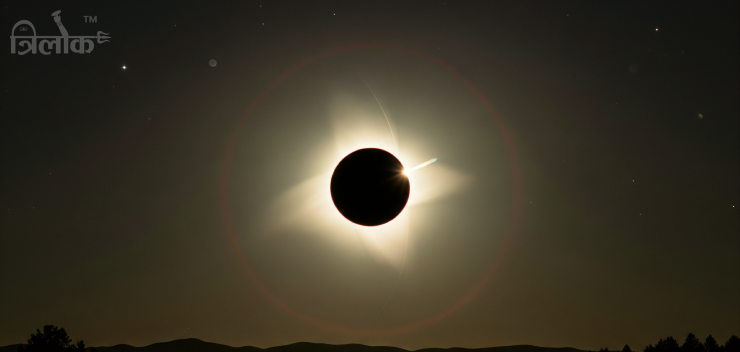
Solar Eclipse 2026 – Two Solar Eclipses Will Occur, Know the Dates
April 27, 2026 Monday
Let’s explore the details of the two solar eclipses occurring in 2026 and whether their Sutak Kaal will be applicable in India.
Solar Eclipse 2026 Schedule
| Event | Date | Type of Eclipse | Visibility in India |
|---|---|---|---|
| First Solar Eclipse | February 17, 2026 (Tuesday) | Annular (Ring of Fire) | No |
| Second Solar Eclipse | August 12, 2026 (Wednesday) | Total Solar Eclipse | No |
1. The First Solar Eclipse (February 17, 2026)
The first solar eclipse of the year coincides with Phalguna Amavasya. This will be an Annular Solar Eclipse, famously known as the “Ring of Fire.” This occurs when the Moon is too far from Earth to completely cover the Sun, leaving a brilliant outer ring of light visible.
Visibility and Sutak:
This eclipse will not be visible in India. It will primarily be seen in South Africa, southern Argentina, and Antarctica. Because it is not visible in the Indian subcontinent, the Sutak period is not applicable for residents here.
2. The Second Solar Eclipse (August 12, 2026)
The second eclipse falls on Shravan Amavasya. This is a Total Solar Eclipse, where the Moon completely obscures the Sun, briefly turning day into night and causing a noticeable drop in temperature.
Visibility and Sutak:
Similar to the first, this eclipse will not be visible in India as it occurs during the nighttime in the region. It will be witnessed in the Arctic, Greenland, Iceland, Spain, and Russia. Since it is not visible, there is no religious requirement to observe the Sutak period in India.
Important Precautions to Follow During an Eclipse
Even if an eclipse is not visible, many choose to follow these traditional Vastu and astrological guidelines to maintain positive energy:
- For Pregnant Women: It is traditionally advised to remain indoors during the eclipse window.
- Mantras: Chanting the Surya Beej Mantra or meditating can help mitigate the subtle energetic shifts.
- Food and Water: Add Tulsi (Basil) leaves to stored water and food containers to maintain purity. It is best to cook and eat fresh meals only after the eclipse ends.
- Purification: Once the eclipse concludes, take a bath and sprinkle Gangajal (holy water) throughout your home and on temple idols.
- Yoga: Engaging in light yoga or meditation helps maintain mental peace and stability.
While these 2026 eclipses are spectacular opportunities for scientists in the southern and northern hemispheres, following these simple Vedic tips can help you stay spiritually grounded.